


What is a Dental Crown?
- Tooth-shaped cap that’s placed over your tooth.
- Protects broken, cracked, damaged or heavily decayed teeth.
- Rebuilds vital tooth structure.
- Costs from £1,025 (ready within the hour).
- Custom-made, permanent restoration that’s fixed in pace.
Dental crowns are a type of dental restoration, like caps cemented on top of damaged or decayed teeth to protect them.
In other scenarios, you’ll likely encounter dental crowns for other dental restoration treatments, such as dental implants or bridges.
However, typically, the primary role of a dental crown is to protect weak teeth and restore a compromised tooth structure, as seen in cases of large cavities. Dental crowns are made from various materials, often determined by the location of the compromised tooth, the patient’s preference and the dentist’s recommendation. See CEREC crowns.
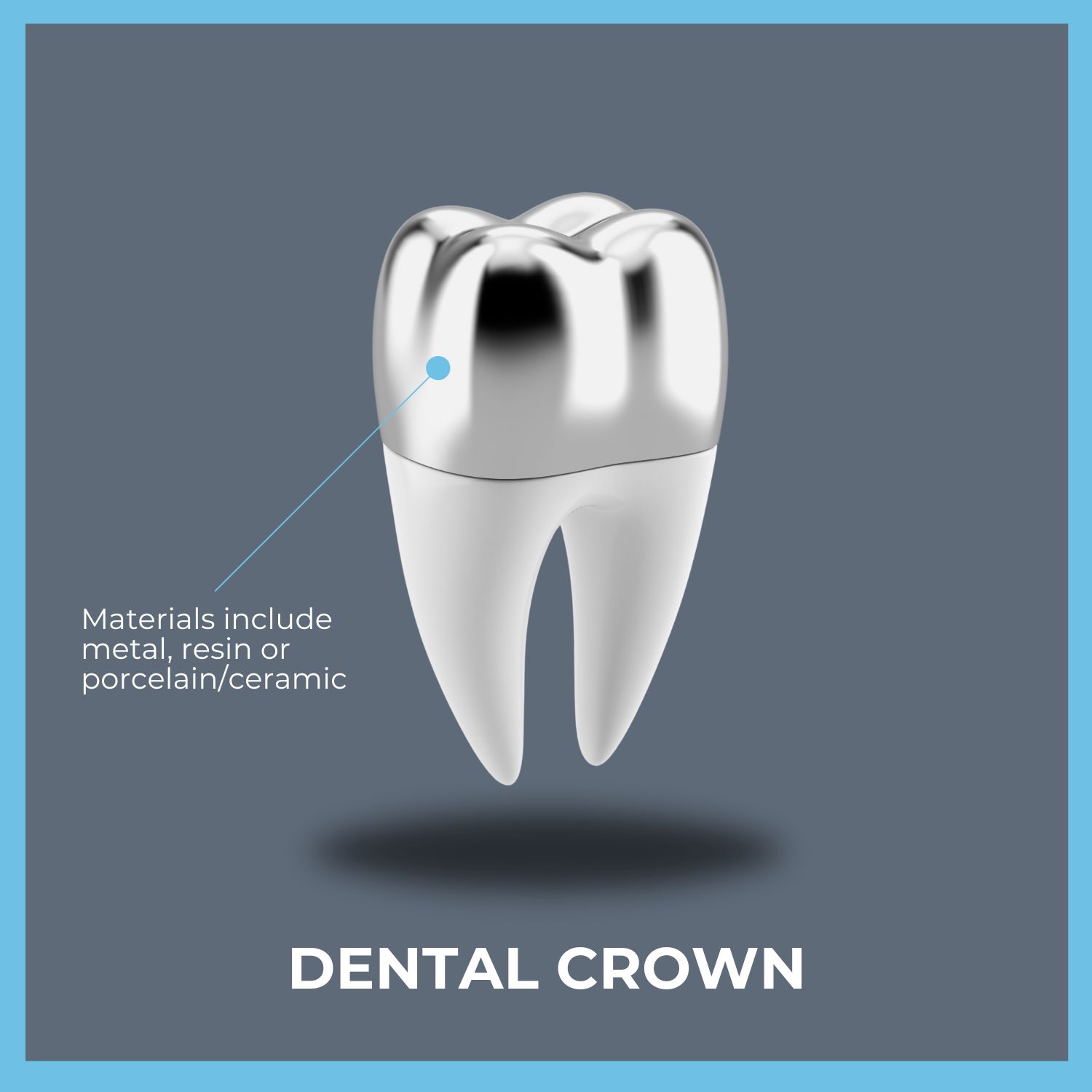
Purpose and function of dental crowns
As you’ll learn, dental crowns serve several needs and functions.
For example, their primary use is to restore the tooth’s shape, size, strength and even appearance when a tooth has become severely worn down, cracked or damaged. In typical general dentistry scenarios, dental crowns protect weak teeth from breaking and hold together parts of a cracked tooth.
On top of this, dental crowns are an essential component in more advanced restorative treatments, for example, they’re used to anchor a dental bridge, cover misshapen or discoloured teeth and as a final prosthetic for a dental implant.
Typical dental crown materials:
Made from gold alloy, palladium, nickel or chromium. Metal crowns are known for their strength, durability and for withstanding tough biting and chewing forces, hence why they’re typically used for rear teeth (molars). That said, their metallic colour makes them a less popular choice, especially for visible teeth.
These dental crowns have a metal underlying structure, but are coated with porcelain, which means they’re stronger than regular porcelain crowns and more aesthetically pleasing than just metal crowns. However, they’re not perfect, because the metal underneath the porcelain cap shows through as a dark line that sits above the gum.
Porcelain crowns provide patients with the most natural colour matches and are a good alternative for those with metal allergies. Primarily used in cases where the front teeth have deteriorated, porcelain crowns are chosen for their natural appearance, but are not as strong as metal or PFM crowns.
One of the cheapest types of dental crowns, resin crowns are less expensive, but not as durable and are known to wear down over time and are more prone to fractures.
Made from a special type of ceramic, zirconia crowns are hailed for their strength, durability and appealing aesthetics, which makes them a valuable option for patients who need durable, strong, but visually appealing solutions.


 Trustindex verifies that the original source of the review is Google.
 Trustindex verifies that the original source of the review is Google.
 Trustindex verifies that the original source of the review is Google.
 Trustindex verifies that the original source of the review is Google.
 Trustindex verifies that the original source of the review is Google.
 Trustindex verifies that the original source of the review is Google.
 Trustindex verifies that the original source of the review is Google.
 Trustindex verifies that the original source of the review is Google.