What Does a Dead Tooth Look Like?
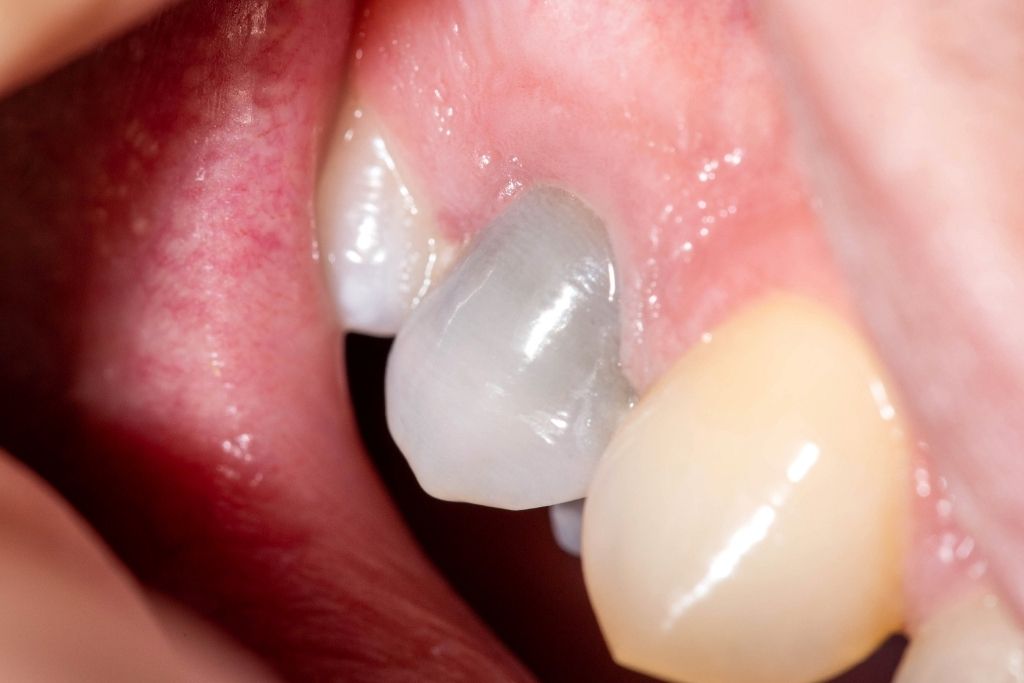
Often, the biggest giveaway for a dead tooth, or pulpless tooth is how it appears. A dead tooth will typically appear darker than other teeth, bruised or discoloured.
It can be difficult to determine whether you have a dead tooth just by looking at it. Sometimes, a dead tooth can cause pain, highlighting reason for concern, but not every patient experiences toothache as a symptom. Pain is not the only symptom you should be looking out for…
Do You Have These 5 Signs of a Dead Tooth?
Dead tooth but no pain? Wondering what a dead tooth looks like? Identifying a dead tooth that’s lost blood flow can be as simple as looking at the tooth’s colour. Does it black marks? Has it turned grey? Is it oddly discoloured compared to your other teeth? The more the tooth deteriorates and decays, the more obvious it will appear.
Dead tooth symptoms:
- Toothache or pain – whether persistent or during certain times.
- Heightened tooth sensitivity to hot or cold beverages.
- Swelling and inflammation around the gum
- Unexplainable bad breath (dead tooth smell)
- Loss of sensation to the tooth (numb)
If you’re experiencing any of the dead tooth symptoms, we would recommend visiting a dentist as soon as possible – treating the symptoms early enough can make all the difference, where the dentist might be able to avoid a root canal and instead use dental techniques to regenerate the tooth’s tissue around the nerve. But time really is of the essence.


 Trustindex verifies that the original source of the review is Google.
 Trustindex verifies that the original source of the review is Google.
 Trustindex verifies that the original source of the review is Google.
 Trustindex verifies that the original source of the review is Google.
 Trustindex verifies that the original source of the review is Google.
 Trustindex verifies that the original source of the review is Google.
 Trustindex verifies that the original source of the review is Google.
Dead tooth guide
A dead tooth is defined as a tooth that no longer receives a fresh supply of blood. Medically, it’s referred to as pulp necrosis, where bacteria enter the pulp through a cavity or crack in the tooth, causing the pulp tissue inside of the tooth to die.
Your tooth is made up of three parts: the enamel (outer layer), the dentin (inner layer) and the pulp (the middle).
When a tooth dies, it becomes a non-vital tooth, where it no longer receives a fresh supply of blood.
As the pulp is a rich resource of blood vessels and nerves, which pumps to keep the tooth alive and healthy, when these vessels and nerves begin to fail from decay, the tooth dies.
Our bodies respond in different ways. Sometimes, a dead tooth can stay in the mouth for days, weeks, months (and sometimes years).
However, if you know you have a dead tooth, it’s best not to ignore it as it can continue to cause serious oral health issues, which results in infections that spread to other teeth and gums, dental abscess, jawbone loss, tenderness, swelling, foul breath and more.
Typically, there are three main reasons why your tooth vessels and nerves die: physical trauma (injury), tooth decay and poor dental hygiene.
Tooth decay is often at the root of all problems, where bacteria build up, infecting the pulp and cutting off its blood flow.
Regular check-ups are important to understand any changes to your teeth you might not be noticing and help prevent more extensive treatments in the future.
Our dentists have saved dead teeth on numerous occasions – but it will depend on the stage. Early diagnoses have the best clinical outcomes. But don’t worry, there’s always a treatment solution we can provide, even if it’s too late to save the tooth. You won’t be left with a gap, if you don’t want one.
For a dead tooth, the root canal will likely be the most appropriate next step.
A root canal, in this instance, will remove the dead pulp, replacing it with a different material, clear out the canals and reseal the tooth to prevent further infection.
Root canal treatments are completed with a dental crown to protect the underlying weakened tooth.
Typically, not opting for a root canal means the tooth will require an extraction, with the patients being able to choose how to replace the tooth (either with a denture, dental bridge or an implant).